
The Challenge
In normal operations, a liner network is a balancing act. Demand shifts with the season, new services open, fuel prices move, and every change raises the same question: how many vessels should each service have, and how fast should they sail to keep a weekly schedule at the lowest cost?
Disruption makes that question urgent. Conflict can make key lanes such as the Red Sea and the Suez Canal, or the Strait of Hormuz, temporarily unsafe, and carriers reroute, for example around the Cape of Good Hope, adding days to every round trip. When the situation eases, the return is rarely all at once: eastbound sailings may go back through the Red Sea while westbound sailings stay on the Cape route for a while to protect freight revenue. How many vessels to move, and from which service, is a constrained optimization problem; reasoning in text, even by a capable language model, cannot answer it reliably.
Why Our Solution Is Different
Everyday Network Planning
- Rebalances vessels and sailing speeds across services as demand, fuel prices or the service network change
- Keeps every service on its weekly schedule at the lowest operating cost
The right fleet for the network you run today.
Scenario-Based Planning for Disruption
- Puts routing scenarios side by side: the current plan, the new routing with the fleet unchanged, and the new routing with the fleet re-optimized
- Shows what each scenario costs per week, and how much of the disruption cost a better deployment recovers
Plan for each way the situation can unfold.
Which Vessels Move, and from Where
- Derives the sailing speed each service needs from the vessels it is given, instead of guessing both separately
- Recommends concrete moves, for example one more vessel on each of two services, instead of a general direction
Right vessels, right services, right speed.
Optimization Where Reasoning Alone Falls Short
- Runs on the SOMR Engine®, which hands decisions like this to simulation and optimization rather than to free-text reasoning
- Plans are proven optimal and checked by an independent verifier; an infeasible scenario reports the vessel shortfall instead of failing silently
Optimal, and checked.
Explore Our EngineAny Trade Lane, Any Situation
- The same analysis applies to other networks and chokepoints, from Asia–Europe to routes affected by the Strait of Hormuz, in normal and disrupted conditions
- Services, routes, fleet size, speed ranges and costs are scenario settings, so a new lane is a new scenario, not a new model
One method, every lane.
Demonstration
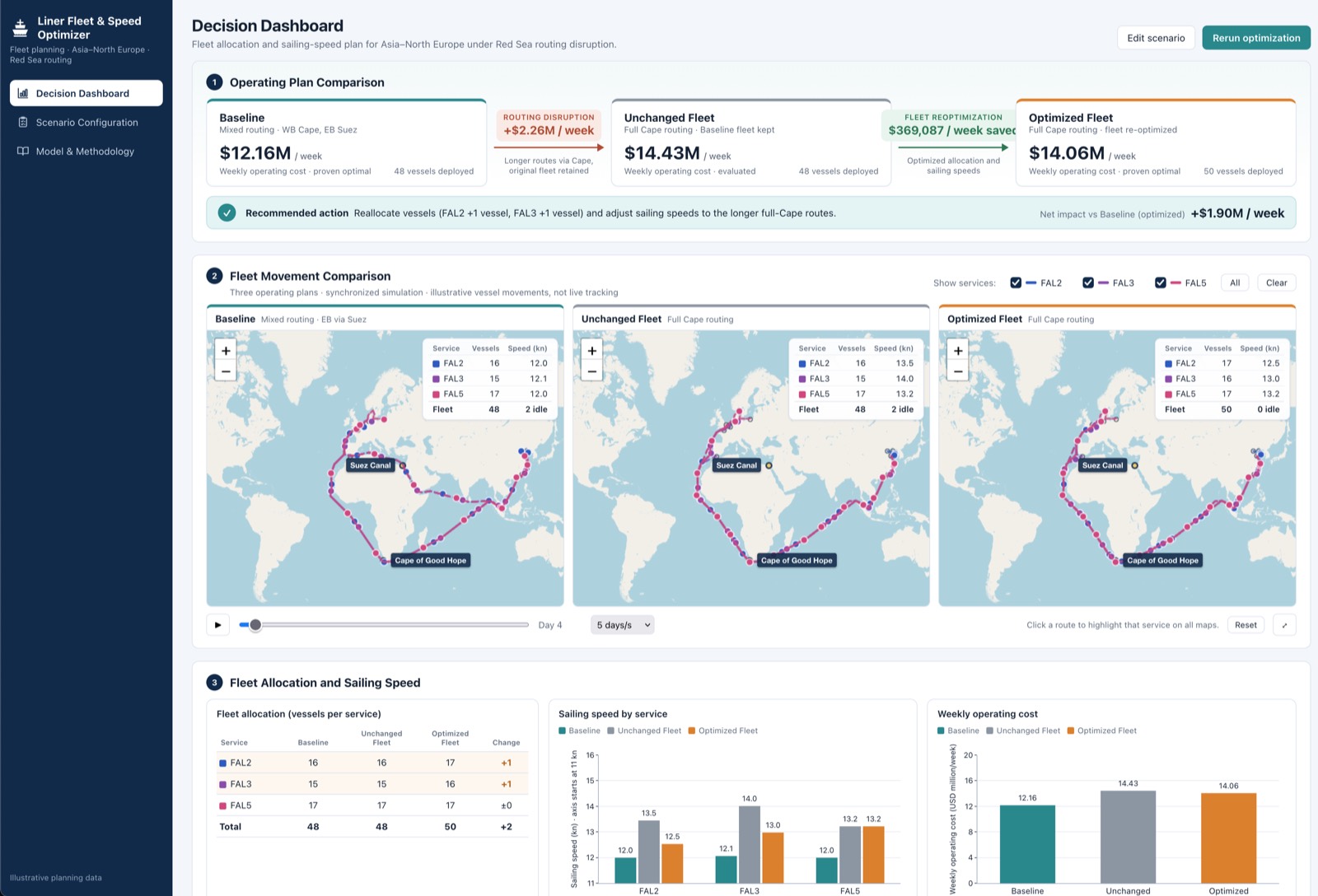
The demo shows the disruption case on an Asia–North Europe network: mixed routing as the baseline, then full Cape routing with the fleet unchanged and with the fleet re-optimized.
Illustrative planning data and assumed cost parameters. Results demonstrate the method and are not a deployment plan for any real carrier.