
The Challenge
Typhoons can interrupt port operations, restrict quay-crane availability, and reduce terminal throughput. Their impacts depend on the interaction between vessel arrivals, berth capacity, operational resources, and disruption duration.
Understanding those consequences requires more than historical weather data. It requires modeling how the port actually operates under stress.
Why Our Solution Is Different
Disruption-Aware Port Simulation
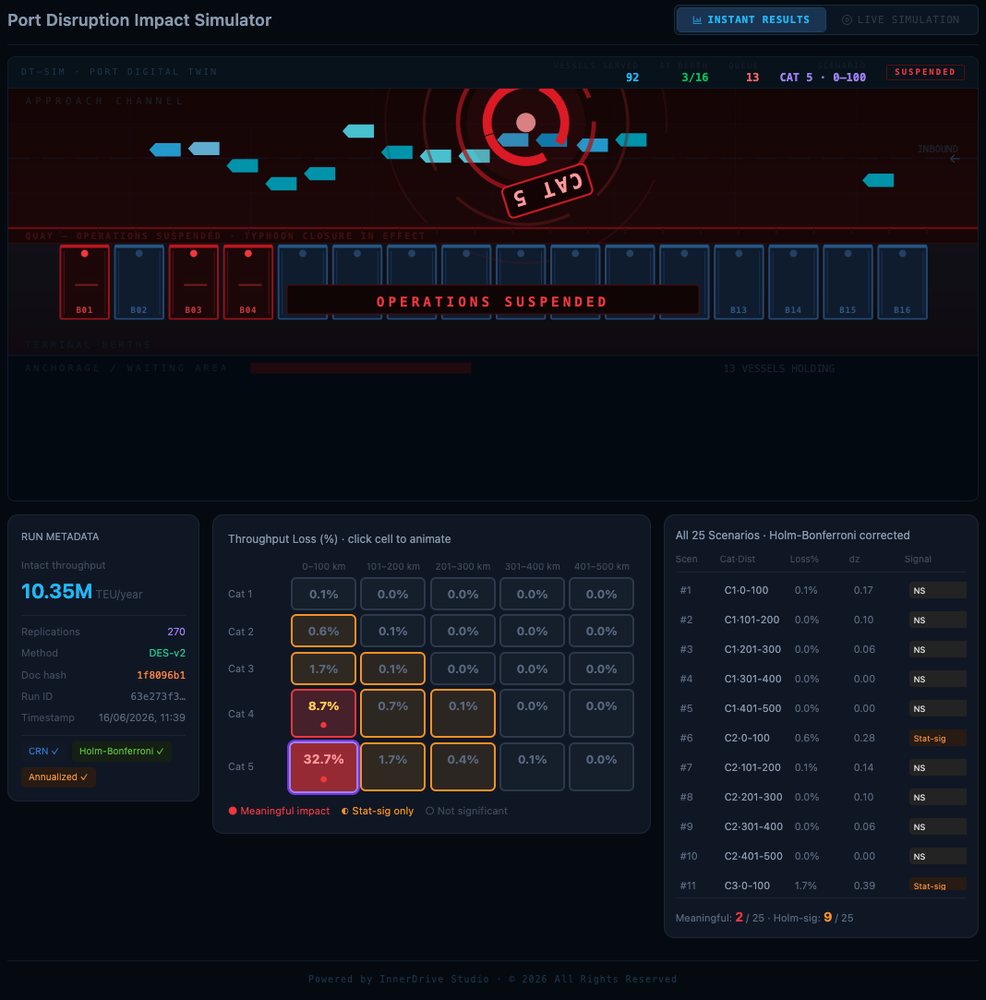
- Models vessel arrivals, berth occupancy, crane capacity, and weather-driven interruptions through discrete-event simulation
- Compares normal operations with alternative typhoon scenarios to estimate changes in port throughput
Explore disruption before it happens.
From Physical Impact to Economic Risk
- Connects simulated operational outcomes with physical and economic loss estimates
- Shows how different disruption scenarios change the estimated scale of port risk
Translate disruption into measurable consequences.
Statistically Defensible Results
- Uses repeated stochastic simulation, common random numbers, and statistical validation techniques to evaluate differences between scenarios
- Separates statistically detectable changes from operationally meaningful effects, with reproducible outputs available for inspection
Beyond a single simulation run.
Interactive Port Digital Twin
- Explores berth-level operations through an animated digital-twin interface and compares scenarios using a 5×5 disruption heatmap
- Switches between precomputed results and live simulation runs
See the disruption. Understand the impact.
Validation & Explore
The engineering workflow includes explicit data contracts, statistical verification and validation, and reproducible run artifacts.
Research-oriented demonstration using synthetic terminal operating data and illustrative validation assumptions. Typhoon tracks use public IBTrACS data. Results are not calibrated forecasts for a specific real terminal.