
The Challenge
Peak volume is expected to grow by 20% next year. Quay cranes are the most visible asset, so adding them is the instinctive answer. But the vessel turnaround depends on the whole chain: quay cranes, horizontal transport and yard handling. If the yard is already saturated, more quay cranes only push more boxes into the same queue.
Choosing the right investment means testing each resource against the others, under realistic variability, before committing capital.
Why Our Solution Is Different
Bottleneck Test, Not Utilisation Guesswork
- Adds a small step of each resource (yard blocks, AGVs, quay cranes) and measures which one actually shortens the vessel turnaround
- Utilisation is shown as a hint; the conclusion rests on what each change does to the turnaround
Busy is not the same as limiting.
Right-Sized Additions
- Adds the limiting resource one unit at a time and recommends the point where the next unit saves too little to justify
- Re-diagnoses after each change, because removing one bottleneck reveals the next
Buy enough, not more.
A Copilot That Shows Its Evidence
- Answers planning questions in plain language, in English or Chinese, with evidence tables under every answer
- Every number in an answer must appear in the simulation results; a check in code rejects numbers it cannot find
Every number traceable to a run.
The Planner Stays in Control
- The copilot can only propose equipment changes; nothing is applied until the planner confirms it
- Spending on the language model is capped per question, per session and per day
Advice from the copilot. Decisions from the planner.
Demonstration
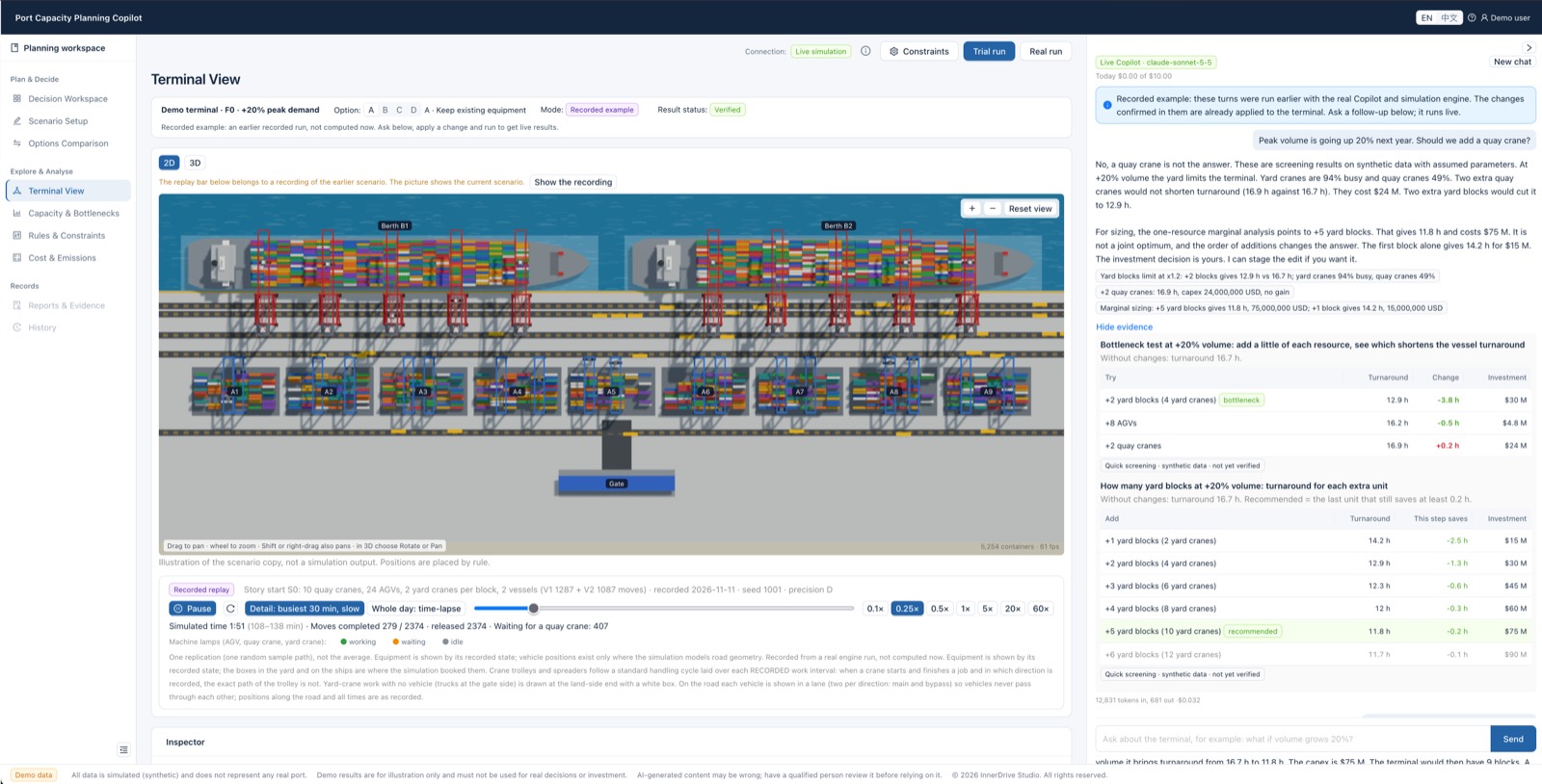
The demo opens with a recorded planning conversation: a 20% volume increase, where the yard turns out to be the first bottleneck and AGVs the next.
Demonstration on a synthetic two-vessel terminal with assumed equipment parameters and prices. Results are quick screening runs and are not calibrated to any real terminal.